
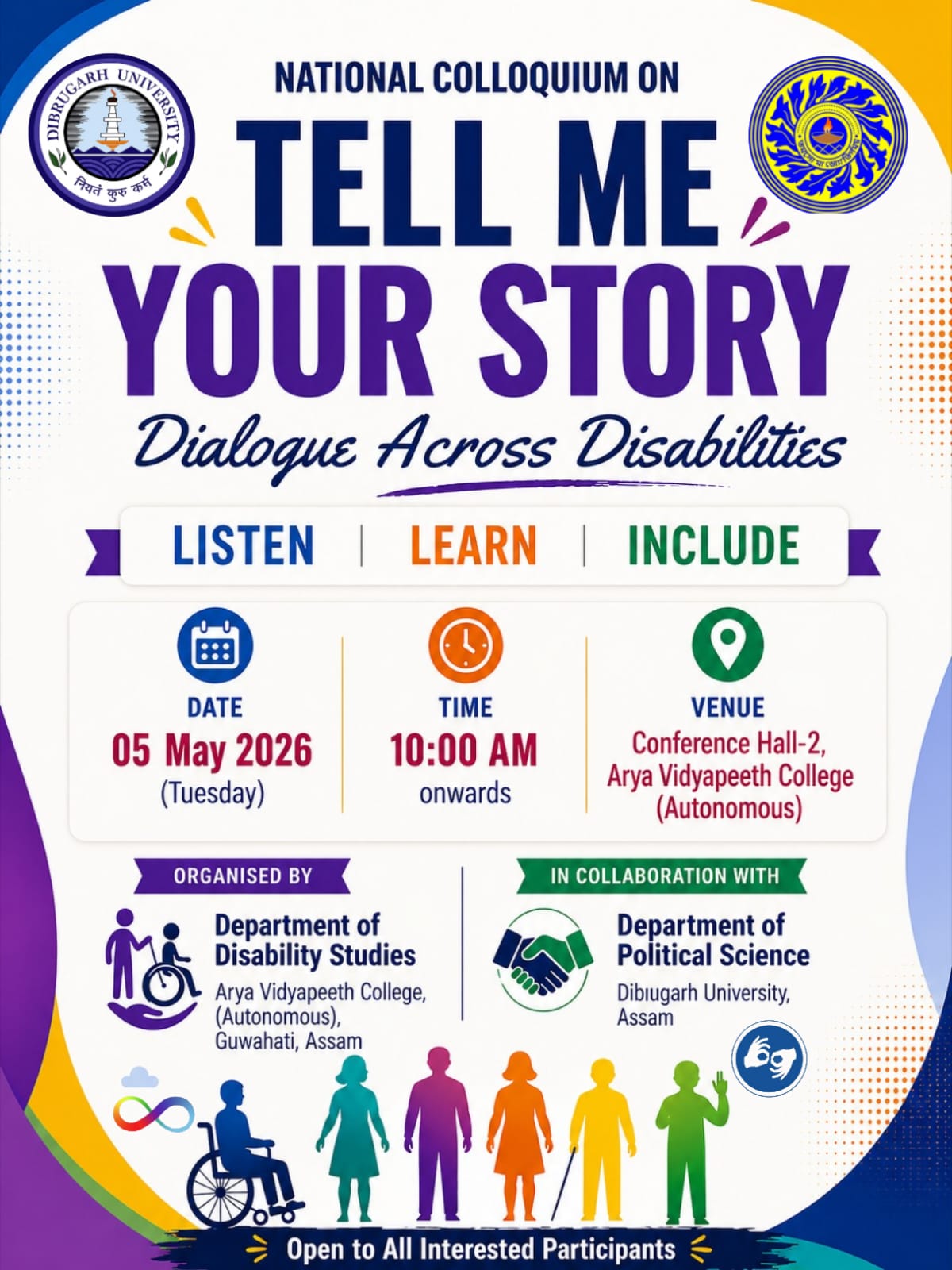
Living with disability carries attached meanings that are differently ingrained from one individual to another. While the term disability in itself immerses into definitional perplexities, the way it is shaped, perceived as well as experienced carries deep seated feelings accompanied by acceptance, pride, joy, adaptations and not ignoring the adjustments at different stages. It is extremely significant to listen, know and understand these feelings that further widens the theoretical apparatus of global disability discourse as well as highlight specific contextual detailing of the way these experiences get shaped, perceived and shifted over time. Highlighting diverse trajectories of disability both in Global North and Global South, the colloquium stresses on the non-uniform and heterogenous nature as well as experiences of disabilities, the latter of which is further conditioned by language, ethnic and cultural influences and contexts too.
Placed in today’s time and context, these experiences either shared through narratives or lectures calls for openness and receptivity for multiple reasons. Primarily it enables a shift from the already acquired knowledge or theoretical constructs of “what we know” to a more nuanced understanding of disability experiences placed in specific cultures and geographical context, most specifically in the Global South. Engaging in such experiences, allows to give voice and agency to the persons with disabilities and at the same time acknowledge the diversity of their experiences. Challenging the dominant perspectives surrounding disability, these experiences further help to deeply engage with temporary facets of abled-bodiedness and its associated ideas such as normalcy, stereotypes, productivity, dependence and more. Beyond that, the lived experiences serves as a gateway for policy makers and analysts to rather dive into more grounded realities while underscoring the need to have informed, responsive and effective laws and policy designs for better empowerment of persons with disabilities in the state.
The colloquium in short proves to be a joint effort to explore disability with specific focus on the lived experiences. The experiences to be shared is expected to serve the understanding that disability is never a single or uniform experience but rather emanating out of diversities and differences. These differences are felt differently across bodies, environment, cultural expressions, social contexts etc. further making it subjective in nature. By engaging in such exercises, the colloquium strives to move beyond theoretical discourses to opening and offering a space where lived experiences are felt, understood and meaningfully engaged with. Such efforts will enable shape future scholarship and bridge the gap between theories and lived experiences while generating critical introspection and greater academic reflexivity.
Aims and Objectives
- To create a space where persons with disabilities can share their voices.
- To facilitate deeper understand and meaningful engagements with the experiences shared.
- To encourage future scholarship that can bridge the gap between theories and lived experiences.
Target Audience
The colloquium is open for all including researchers, students, policy makers, activists and other interested stakeholders from various backgrounds. While it specifically aims to engage interested individuals in disability studies or researches, it also encourages active participation of students and scholars with disability to ensure their voices and perspectives remains central to the discussions carried through the colloquium.
Expected Outcome
- Developing deeper understanding on disability, not just as an idea but a living condition faced with differences in experiences.
- Hearing, Acknowledging and valuing the voices of persons with disabilities.
- Developing deeper understanding on disability, not just as an idea but a living condition faced with differences in experiences.
- Fostering critical mindsets that introspects on disability and its multiple interpretations, further guiding future discussions, scholarships and insights on the same.
- Creating a more informed and engaged audience, that can simultaneously contribute to inclusion and empowerment of persons with disabilities.
Methodology
The colloquium shall adhere to a participatory and multidisciplinary approach, in order to ensure meaningful engagements for the targeted audience. Combining both academic and participatory approach, the meeting will consist of keynote lectures, personal accounts, narratives or stories and shared by persons with disabilities, followed by short interactive session at the end.
Organisers
Department of Disability Studies, Arya Vidyapeeth College, Guwahati Assam in collaboration with Department of Political Science, Dibrugarh University, Assam.
